

For years, games generated the most in-app purchase revenue in the mobile app economy. That's changed. In 2025, non-gaming apps earned more from in-app purchases than games did — $85.6 billion versus $81.8 billion. The gap is likely to keep growing, so if you've been treating "games monetize, other apps don't" as a rule, it's time to rethink that.
What actually happened
Non-gaming apps have been catching up to games for ten years. In 2025, they finally passed them. Non-gaming app revenue increased by 21% YoY, while games grew by just 1%. Games aren't shrinking — they're just expanding much more slowly than before, while non-gaming apps kept climbing steadily until they caught up.
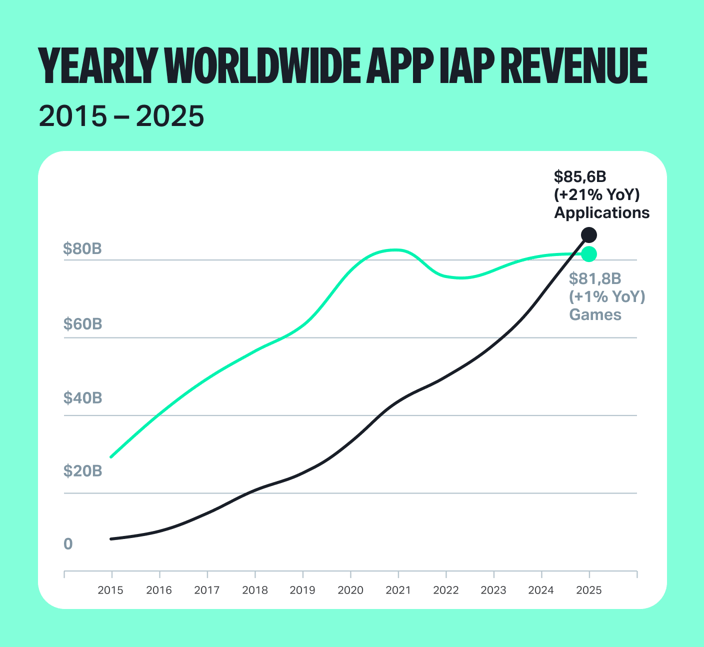
Sensor Tower, State of Mobile 2026 Report
Recent gaming-industry data shows why games slowed down. Downloads are actually falling, not just flattening — down 5.7% YoY on the App Store and 7.3% on Google Play. At the same time, more new games keep showing up in these stores (App Store titles up 11.4%, Google Play up 45.9%). So more games are competing for fewer downloads. That’s a harder market challenge than the "1% revenue growth" number alone suggests.
Revenue by platform tells the same story: App Store revenue increased by just 0.6% in 2025 to $52.5B, and Google Play revenue increased by 2.8% to $30B — both far behind non-gaming's 21% growth. One more clue is that this is a mobile-specific problem: Steam, the PC gaming store, expanded by 13% to $11.7B in the same period. So it’s not that gaming is struggling everywhere — it’s a mobile app-store problem.
User behavior data backs this up. Overall game installs and sessions barely moved in 2025 (sessions up just 1% YoY). The one exception was casual games, where installs grew by 19% and people played longer sessions (up by 15%, to almost 26 minutes). Even the one genre that's still growing is doing so because people play more, not because it's attracting a lot of new players.
Which non-gaming categories are actually driving this
The 21% growth in non-gaming apps didn’t come from one place — it was spread across several types of apps. AI apps added the most new revenue in 2025, at $3.5B (ChatGPT alone was the third-highest-earning app of the year, right behind TikTok and Google One). After that came movies & TV apps (+$2.2B), social media (+$2.1B), utility apps (+$1.8B), and multimedia & design apps (+$1.4B). The rest came from smaller categories like productivity software, health apps, and education apps.
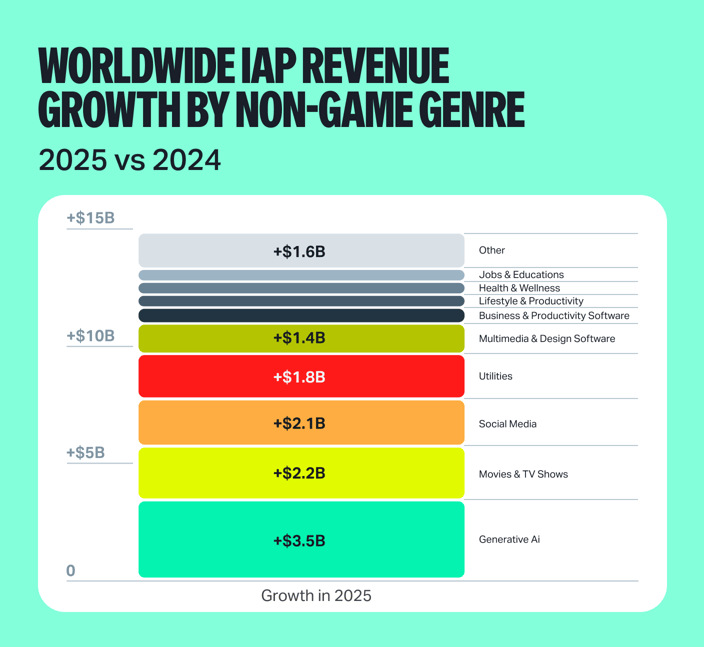
Sensor Tower, State of Mobile 2026 Report
AI is the single biggest piece, but it's still less than a third of all the new revenue. Social media, streaming, and utility apps together add up to more than AI does. So this isn't really an "AI had a good year" story. It’s more that a lot of different app types are now using the same trick games have used for years: give away enough for free to hook people, then charge for the part they actually want.
The US and Europe look different
Regional trends also show that growth is coming from different markets. If you're focused on the US or Europe, the picture isn't the same in both regions. Consumers in the US spent nearly $60 billion in 2025 — still the biggest mobile market by revenue. But that money is coming more and more from people who already use the app, not from new users, since US downloads have been stagnant for a while. Europe is different — most of the actual non-gaming revenue growth is coming from there, while the US market has stayed relatively stable. In short: in the US, focus on getting more value from the users you already have. In Europe, there’s still real room to grow by bringing in new users too.
What this means for your app
The takeaway isn't "stop making games." It's that you can't decide between ads and in-app purchases just by looking at what kind of app you have anymore. Ask yourself:
- Does your free version give people enough reason to want more — or are you asking them to pay too soon, or for the wrong thing?
- If in-app purchases don't fit your app, are you at least earning from ads — or are you leaving that money on the table?
- If you're in the US and growth has slowed, are you focused on getting more value from existing users — or still chasing new installs in a market where that's not where the money is anymore?
The app category many developers once considered harder to monetize just passed the one that built the mobile industry. That's a good reason to check how your own app makes money, rather than assume it should look a certain way just because of what kind of app it is.
How Yango Ads App Monetization can help
If this shift means adding or rebalancing your ad revenue, App Monetization is built to make that a quick change, not a rebuild:
- One account for every ad network. Instead of managing 16+ ad networks yourself, you get one account with access to all of them. No juggling contracts or logins.
- Our team sets it up for you. We configure your ad units and monetization strategy, then keep an eye on performance and adjust it over time. You don't need in-house ad experts.
- In-App Bidding + Smart Waterfall together. Every ad slot automatically goes to whichever network pays the most. No manual tuning needed.
- One payout, once a month. We combine revenue from every ad network and pay you once, so you're not stuck waiting on separate payout thresholds.
- Fast setup, no disruption. Setup takes days, not months. You can start earning ad revenue alongside your current in-app purchases without pausing other work.
- Legal compliance handled. We take care of ad-market rules in each region you work in, so you don’t have to.

.png)
.png)
.png)