
Your messaging Is the problem, not your funnel
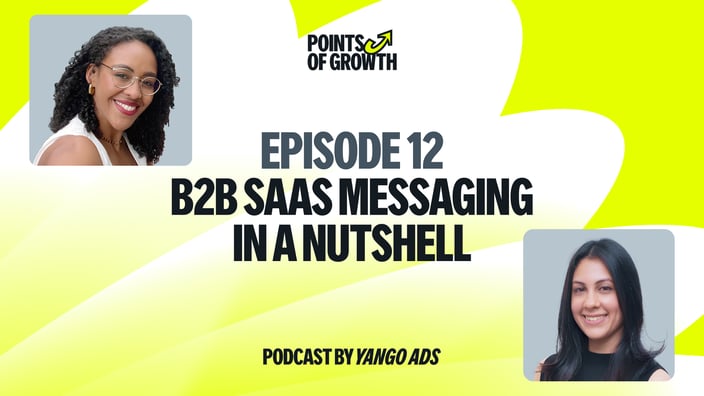
In the highly competitive B2B saas market, are your communications truly connecting or just adding to the clutter? In today’s episode, we’re tackling one of the most critical, yet often misunderstood, elements of scaling and growing a SaaS company: achieving message-market fit.
With our expert guest, Diane Wiredu, who is a messaging strategist and founder of Lionwords consultancy, we explore why your current message might be falling flat and provide a clear playbook to fix it. Diane walks us through a brilliantly simple four-part framework for building a value proposition that connects and converts.
We also discuss how to apply timeless storytelling principles to engage B2B buyers. You'll learn the key internal and external signals that mean it’s time for a complete messaging reset. Furthermore, we explore how to measure the true impact of that message, looking beyond simple conversion rates to metrics like internal alignment and lead quality.
Listen to the full episode now to transform your message and fuel your growth.
Episode 12. B2B saas messaging in a nutshell
Transcript
Neha:
Welcome back to another episode of the Points of Growth podcast by Yango Ads, where we explore the ever-changing landscape of ad tech. I’m your host, Neha Dewar. So far, we’ve been focusing on technologies that drive attention and sell. But today, we’re taking a step aside to discuss how to create strong positioning and message–market fit for complex SaaS technologies. That’s a topic almost every founder and CMO believes they’ve cracked—until conversion rates start slipping and the pipeline suddenly feels harder to fill. To help us navigate this, we’re joined by someone who lives and breathes SaaS messaging. Diane Wiredu is the founder of Lionwords and a trusted advisor to tech companies that want messaging that actually works. Diane, it’s wonderful to have you here.
Diane:
Thanks for having me. I’m excited to be here.
Neha:
My favorite question to start every podcast: could you introduce yourself—both professionally and in a way that tells us a little about the person behind the strategist?
Diane:
Sure. I’m Diane Wiredu. I’m a messaging strategist and conversion copywriter, and, as you said, the founder of Lionwords, which is a messaging consultancy for B2B tech and SaaS. Professionally, what I do is help teams create clear, compelling messaging that resonates with potential buyers. It’s pretty niche, but the impact is huge. It’s all about making the value of your product or service much easier to understand, so you can cut through category noise, get better results from your marketing, and ultimately sell more. On a personal note, an interesting angle is how I got here. Many moons ago, I was actually a linguist—I studied languages. I really believe in the power of words. Communication has always been at the forefront of my work, and I have a very analytical eye for how we communicate and express ourselves. I speak five languages—sometimes I say four and a half, because one of them isn’t my strongest. Over the years, I’ve unpacked not only how we communicate cross-culturally, but also how we explain what our products and services do and how they help buyers.
Neha:
In highly competitive and crowded markets, with so many rival tools—especially in ad tech—how can companies differentiate themselves?
Diane:
First, differentiation isn’t something you can just sprinkle on. A lot of companies come to me saying, “Help us differentiate—rewrite the website and add some differentiation.” Unfortunately, it doesn’t work like that. Differentiation is strategic. You have to define it, and you have to make a bet. Positioning is really about making hard decisions. Often, you need to do some work to uncover what truly makes you different. There have never been more products or more competition than there are today—across tech, ad tech, SaaS, and services. Differentiation is always relative to your positioning: how you position yourself in the market and against competitive alternatives. What are buyers comparing you to? It doesn’t make sense to differentiate on something buyers don’t care about. Your differentiation is relative to your ICP and the value you offer. Once you uncover that core seed—what actually makes you different—you can shape it through messaging, brand, and experience. I don’t think differentiation has to be radical. There’s a movement toward “radical differentiation,” but often it’s something small. It just needs to be relevant to your buyers.
Neha:
Have you ever seen a company where you thought, “Wow, this is real differentiation”? You don’t have to name names.
Diane:
It’s rare. Truly “wow” differentiation usually comes from very innovative companies that appear out of nowhere. For example, if we look at the recent movement around “vibe coding” and companies like Lovable—it’s on everyone’s tongue. What they did to democratize tech and AI was genuinely different. Then you saw hundreds of other companies pop up, trying to do the same thing and even copy their messaging. Everyone started piggybacking off the same homepage ideas, like “What are you going to build today?” That kind of differentiation is rare. Most companies differentiate in less sexy ways—but that’s okay. As long as it matters to your audience and clearly shows why they should choose you, it doesn’t have to be mind-blowing. Honestly, the unsexy stuff is often the most profitable: deeply understanding your buyer and serving them slightly better than everyone else.
Neha:
Let’s talk about messaging. Complex tech products often lean heavily on data, metrics, and rational arguments, but buying decisions are still made by humans. What role does storytelling play in engaging B2B buyers?
Diane:
From an emotional perspective, storytelling is huge. It’s gotten a bad reputation because it’s become a buzzword, but buying decisions are still emotional. Nobody makes decisions purely on logic—even the most logical people. We make emotional decisions and then justify them with logic. For example, we don’t always choose the biggest incumbent solution because it’s objectively better. Often, it’s because it feels safer. We evaluate software or agencies and default to a certain player based on gut feeling, then justify it later with stats. So in messaging, data and metrics are important, but we also need to appeal to emotion. I have a love-hate relationship with the word “storytelling” because B2B storytelling isn’t traditional storytelling. We’re not writing novels. We don’t have time to build character arcs. Sometimes we need to educate and sell in a three-line email or a homepage headline. What I prefer is borrowing principles from storytelling. Familiarity, for example—people want to feel seen. Your buyer should recognize themselves in your messaging. Another principle is conflict. Every good story has conflict. In messaging, that can mean picking a battle or calling out an enemy. Storytelling is important, but we need to make it practical. Otherwise, it becomes an empty buzzword.
Neha:
I have a love-hate relationship with many things—including AI.
Diane:
I understand completely. AI is a perfect example. Storytelling around AI is critical, and many companies miss the emotional angle. They lead with “AI-powered” and lists of capabilities, while buyers think, “Okay, but what does this mean for me?” The companies doing better lead with outcomes—what AI enables for the buyer—rather than leading with the technology itself.
Neha:
How do you balance technical complexity with clarity and simplicity in messaging, without oversimplifying or misleading buyers? Do you have a framework for translating features into value?
Diane:
I work with very technical products. I’m currently working on one where it took me a week just to understand what they do—because the messaging was either too technical or too vague. The first thing to clarify is this: technical doesn’t mean complex. Messaging doesn’t need to be complicated. Buyers—CTOs, CFOs, heads of integration—are still humans. Successful messaging starts with understanding your audience. For me, good messaging needs to be clear, easy to understand, and relevant. Relevance is key. When messaging is vague, it’s usually because it’s not specific enough—or because we’re afraid to really speak to our buyers. For example, saying “transform your business finances” is vague. Hundreds of companies say that. But saying “finally feel on top of your finances and stop your accountant breathing down your neck” speaks to a specific pain. One framework we use at Lionwords starts with the old way: how buyers did things before. Then the problem with that way. Then, “now you can…”—connecting to a new capability enabled by the product. Finally, the outcome or gain. Old way → pain → product capability → outcome. This helps balance technical features with emotional and practical value.
Neha:
That’s so simple—and brilliant. I was expecting a huge, complex framework.
Diane:
Simplicity works. You can apply this at the company level or all the way down to individual features. It helps clarify what value buyers get from each feature and how it changes their experience.
Neha:
At what point in a company’s growth is it most critical to revisit messaging and positioning?
Diane:
There’s no fixed frequency. Some of the smartest companies revisit messaging constantly. But there are clear signals. Internally, big shifts—funding, acquisition, expansion, new product lines—are key moments. Externally, market shifts matter. If competitors catch up to what used to differentiate you, it’s time to revisit positioning. Another major signal is buyer confusion. If you can’t explain what you do in one sentence and rely on demos for understanding, that’s a red flag. That’s usually a messaging and positioning problem—not a funnel problem.
Neha:
Do you have a case where messaging really made a difference?
Diane:
Messaging always makes a difference. It’s the foundation of sales and marketing. Often, the first impact is internal alignment—getting leadership, sales, and product teams aligned around one story. External impact comes with consistency and time. Messaging isn’t a one-day fix; it requires testing and feedback loops.
Neha:
Let’s go back to AI. What’s your take on AI and content creation?
Diane:
I’m nuanced. I’m bullish on AI for productivity and research. I use it to analyze data, surface themes, and challenge my thinking. But for messaging and copy creation, I’m cautious. Communication is too important to delegate entirely to generative AI trained on existing content. AI is great for synthesis, editing, and refinement—but ideation, narrative, and strategy should remain human.
Neha:
How do you measure whether new messaging is working?
Diane:
Start with a benchmark. What are you trying to fix? Often it’s internal alignment first. Then look at qualitative feedback—message testing with real buyers is incredibly valuable. Quantitative metrics like conversions matter, but they can be misleading. Sometimes good messaging repels the wrong buyers. Better signals include sales conversations where prospects already understand the value. You need to look across multiple touchpoints, both internal and external.
Neha:
When people say someone spent 30 minutes on their website, I’m like, “They probably went to get a glass of water.”
Diane:
Exactly. B2B buying journeys are long and complex—often 200+ days. No single metric tells the full story.
Neha:
Diane, this has been incredibly insightful. Thank you for unpacking such a misunderstood but critical aspect of SaaS growth. To everyone listening, thank you for tuning in to Points of Growth. If you enjoyed this conversation, share it with a founder or marketer wrestling with messaging. Subscribe for more deep dives into the science and strategy of growth. Until next time, keep building, keep experimenting, and keep finding your points of growth.
Diane:
Thanks for having me.
Want the episode transcript?
Share your details below to get instant access