



April 6, 2026
Why playable ads rule UA: Trends, formats & winning concepts
.png?width=721&height=502&name=1%20(1).png)
Playable ads aren’t just a trend — they’re one of the most powerful creative formats in user acquisition today. In this first part, I’ll break down why they work, what’s driving their popularity, and which formats are leading the pack.
I’ll look at everything from video playables to non-core gamified ads in dating and e-commerce, zeroing in on what’s actually winning attention and installs right now. The tone is conversational (with a wink here and there), but everything’s grounded in real data and examples. Let’s dive in!
Why should you care about playables?
Playables aren’t just novel — they generate much higher conversion rates than static or even standard video ads. In fact,playable ads drive conversion rates 27× higher than banner ads, and even outperform regular video ads, which see about 23× higher conversion versus banners. Playables have gone mainstream in UA, especially on networks outside the big social platforms.
Playables are mandatory for running UA outside of Facebook, Google, and TikTok. If you don’t have playables, you can’t scale—full stop.
That may sound extreme, but it shows just how essential interactive ads have become on channels like Applovin, Unity Ads, IronSource, and other SDK networks. Even non-gaming apps are getting in on the action. More than 50% of the top 100 new creatives on Applovin were for non-gaming apps — think VPNs, finance apps, photo editors, and more. Playables aren’t just for games anymore. So, the next time someone claims “playables are only for games,” you have permission to roll your eyes.
What’s driving this trend? UA managers have realized that playables can diversify creative strategy and unlock new audiences. They add variety to campaigns and provide a “no-brainer” testing tool in the creative mix. With many easy drag-and-drop tools available now, like PlayableMaker (ehm ehm), you don’t need to be a coding wizard to produce them. Simply put, playables offer a potent combination of high engagement and (relatively) low production cost, making them a hot commodity in the UA landscape.
Anatomy of a Playable: Key Components and Alignment with Goals
Designing a great playable is part art, part science. The most effective playables tend to share five key components:
.png?width=721&height=502&name=2%20(1).png)
- Intro: A brief attention-grabber to hook the user. This could be a catchy graphic, an opening animation, or a tempting question. For example, an intro screen might show two characters squaring off with a prompt “Ready for a race?” and a big “Race Now” button. The goal is to stop the scroll and say, “Hey, try this!”
- Tutorial or cue: A quick how-to-play guide, if needed. The best playables keep this super simple — maybe a single screen with an arrow pointing to what to tap, or even no explicit tutorial at all if the game mechanic is intuitive. Remember, you’ve only got a few seconds to teach the user.
For instance, the Tap Gallery playable shown above succeeded because its gameplay was instantly understandable and “required no tutorial.” It’s wise to use visual cues (highlighted objects, icons, a “Tap here!” pointer finger) instead of text-heavy instructions. Some playables even use a few quick ghost taps or a looping demo to show the user what to do, without needing a separate tutorial screen.
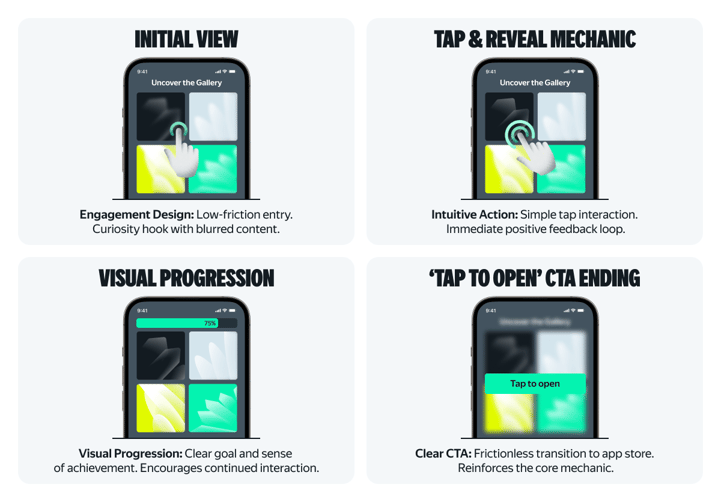
- Core gameplay:This is the interactive heart of the ad — where the user actually plays. It might mean swiping to match gems, tapping enemies, or dragging items to solve a puzzle. This segment should be a simplified version of your app’s actual gameplay or a key feature, tailored for a 15–30 second experience. Align it with your game’s core loop or value proposition. If you’re advertising a strategy builder, maybe the playable has the user construct a building or defend a base. If it’s a puzzle game, let them solve one quick puzzle. Don’t stray too far from what the real product offers. The best playables set correct expectations: Еhe ad’s mechanics perfectly match the actual gameplay, creating a seamless experience that builds trust and engages players.
- Feedback: Visual or audio rewards that give the user a sense of accomplishment — or add a touch of drama if they fail. This could be points, a “Success!” or “Failed!” message, stars, progress bars, or celebratory effects. Positive feedback is crucial — you want the user to feel good about interacting. Even if there’s a fail scenario, it’s often best to let the user succeed by the end (perhaps by letting them try again or using a hint) so they don’t leave the ad frustrated. A little dopamine goes a long way. In the Tap Gallery example, every tap was met with satisfying feedback, making the ad fun and keeping users engaged.
- Call-to-Action: The grand finale is prompting the user to install or learn more. This usually appears as a clickable button or end card, often saying “Download Now,” “Install,” “Play Free,” etc. A strong CTA is clear, compelling, and ideally feels like a natural next step in the experience. Some playables integrate the CTA throughout (e.g. a persistent “Download Now” button visible during gameplay) or present it as the conclusion of the mini-game.
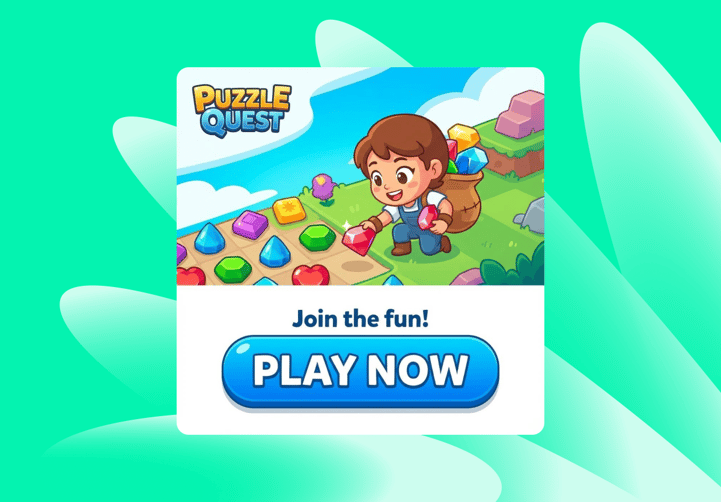
Finally, alignment with your game or app’s goals is the golden thread through all these components. Every part of the playable ad should reinforce what makes your app appealing and drive the user toward conversion. If your game’s appeal is competitive PvP, your playable might be a 1v1 mini-duel that captures that thrill. If it’s a shopping app, maybe the playable is a quick “find the best outfit” challenge. Always ask: does this playable experience connect logically to my product’s core loop or selling point? A seamless transition from ad to app not only boosts installs—it sets up better post-install retention because users get what they expected.
Case in point: “That’s My Seat” by Rooftop Game earned praise because the playable ad’s mechanics matched the game exactly, ensuring players knew what to expect after downloading. It built trust and kept players engaged beyond the ad. So, whether you’re showing off an app’s feature or a game’s core mechanic, keep it real and relevant.
The takeaway: Match your message to your product, and you’ll attract users who stick around.
Hot Playable Ad Formats and Trends
The playable ad format isn’t one-size-fits-all. We have seen several creative trends emerge in the last few months, blending videos with interactivity and trying new twists on gameplay. Below are the key formats and trends making waves.
Video Playables with Persistent CTAs
Why choose between video and playable when you can have both? Video playables combine the eye-catching storytelling of video with a playable element — typically by overlaying a persistent CTA button on a video clip. Essentially, it’s a short video ad (sometimes actual gameplay footage, sometimes a flashy animation or trailer) that the user can watch or skip at any time by tapping the install button. The CTA is visible throughout the video, so the moment a user decides “Okay, I’m sold,” they can click through immediately — be it 2 seconds or 20 seconds in. This format simplifies the user journey by allowing users to act at any moment… at the start, middle, or end of the video, which is great for impatient viewers. No need to wait till the end card to convert.
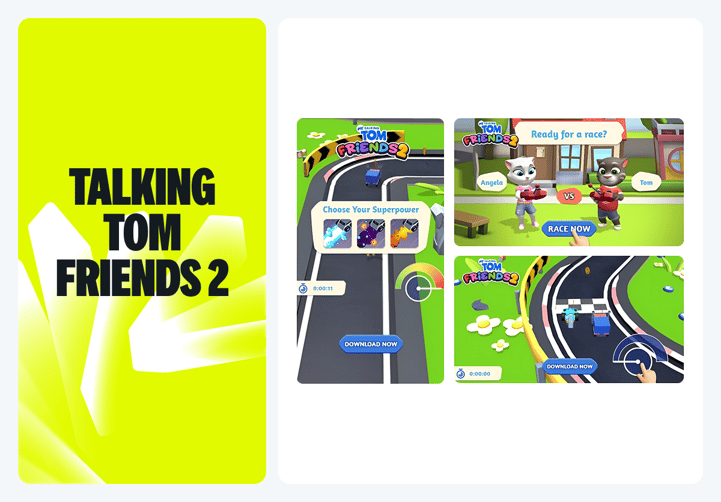
Example: A playable ad for Talking Tom Friends 2 features a racing duel video with interactive elements. The ad starts with an enticing prompt—“Ready for a race?”—showing Angela vs Tom and a big “Race Now” button. As the video progresses, a “Download Now” button stays on-screen while the cars speed down the track. The user can even “Choose Your Superpower” using on-screen buttons during the race. Throughout, the persistent CTA invites the user to install at any moment. This hybrid approach combines the engagement of playables (choosing power-ups, steering) with the visual appeal of video, keeping the app store just one tap away.
Video playables are a perfect onboarding for advertisers new to playables, because they’re relatively low-effort. “A simple video bundled in HTML with a CTA is all it takes to begin. By not leveraging this format, you’re potentially missing out on a low-effort yet effective channel to boost conversions.” They’re lightweight compared to fully coded mini-games, and familiar to users — people are used to video ads, so adding a clickable button feels natural.Importantly, this format can capture quick deciders.
The persistent CTA keeps action top of mind, building urgency while the video content captures attention and highlights key app benefits.
The format is especially effective for campaigns seeking immediate conversions, like hyper-casual games or utility apps where a simple video and a constant “Install now” button can seal the deal. In short, video playables are here to stay. They offer a taste of interactivity without the heavy lift of a full game demo. If you’re unsure where to start, this is an easy entry point.
Interactive End Cards
Not every “playable” needs complex gameplay. Interactive end cards — essentially static or looping visuals with a simple interactive element and a CTA. These are those ads that might show a short animation or a rotating 3D object, then present a “Tap to try” or just a blinking “Download” button on top of it. It’s minimal on gameplay but high on clarity. In fact, clickable end cards have become the most common new playable format across many networks because “they’re simple, effective, and straight to the point.” They strip away fluff: no elaborate intro or multi-step gameplay – just an attractive graphic or looped video and a big CTA.
Simplicity drives action. Users in the wild are inundated with ads; a no-nonsense end card that says “Download now to do X” can cut through the noise. As one report put it, these ads “feature a clean and visually appealing design with a Call-to-Action. No drama, no unnecessary hooks — just a straightforward ‘click here to download’ approach.” In a world full of distractions, many users actually appreciate the directness — a simple clickable end card gets straight to the point without overwhelming the audience.
For advertisers, they’re cheaper and faster to produce, with no complex coding or level design required. Plus, the format has universal appeal — it works for casual puzzles, hardcore RPGs, or finance apps alike.
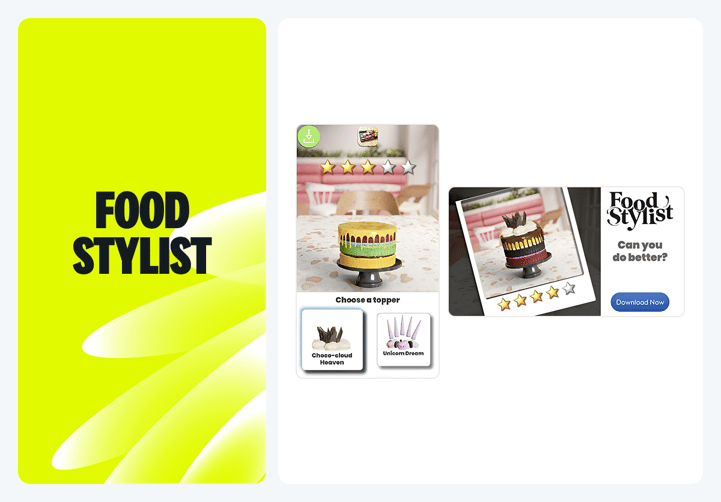
Example: An interactive end card for Food Stylist shows the impact of a simple, smart finish. In this playable, users design a wedding cake by choosing frosting and toppers. When finished, instead of just saying “Congrats,” the ad transitions to a final screen with the Food Stylist logo, a photo of the completed cake, a star rating (like 4 out of 5 stars), and the question: “Can you do better?” next to a Download Now button. The end card is interactive — it shows the user’s creation, engages their pride, and makes the CTA part of a challenge. This looping scene is simple — basically an image with text — but it’s highly effective. Users see their cake, feel a sense of victory or the urge to improve it, and are one tap away from installing to try in the full game.
Interactive end cards like this highlight a trend of using psychology and minimalism: A bit of feedback (stars, score, or “you failed/succeeded”) and a clear CTA that often doubles as a dare or invitation. They are easy to iterate on — you can swap backgrounds, images, or text quickly to A/B test messages. And data backs their performance: these end-card-centric playables often outperform static image ads by keeping users visually engaged longer. With the help of AI tools, marketers can even generate tons of variants of these with minimal effort.
In sum, the interactive end card trend shows that sometimes less is more – one screen, one button, done. It’s the low-hanging fruit of playables that every UA manager should have in their toolkit.
Fail/Win Scenarios and Simulation-Based Playables
Ever see an ad where the player fails miserably, and you think, “Ugh, I could do better”? That’s on purpose! Fail-playables (a term for playables designed to show a failure scenario) and their counterpart win-playables are popular formats used to provoke user emotion. The idea is either to frustrate viewers just enough that they need to install to fix it, or to give them a taste of victory so sweet they want more. Many top studios are experimenting with these mechanics in playables. For example, FunPlus was “utilizing all kinds of playable ads — point-and-click, upgrading buildings, progression playables, unlocking characters, interactive options, choosing an object, fail playables, and more!” It’s a full creative arsenal.
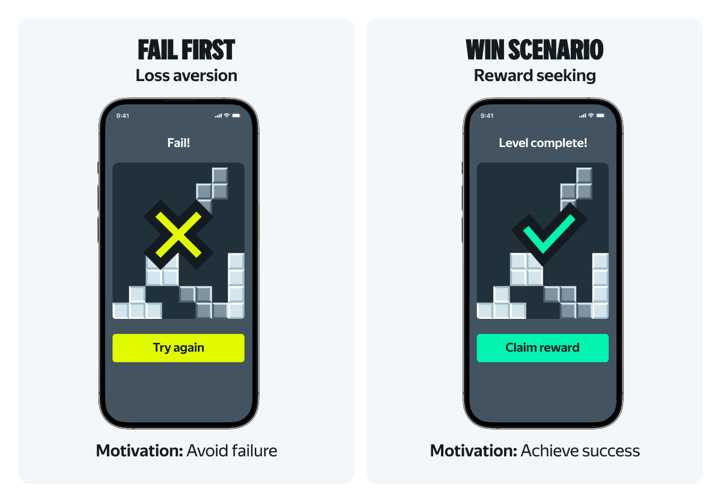
Fail scenarios often involve intentionally making the wrong choice in the ad (the character dies or the puzzle isn’t solved), then prompting the user to try for themselves by installing. These can be very effective for certain genres (puzzle games, escape room games, strategy games) where a challenge triggers the problem-solving itch. However, use failure carefully – if the failure in the ad feels frustrating or unfair, it might turn users off. Some advertisers design the playable so the user will fail the first time, then on a second try within the ad they can succeed (and then see a CTA to continue the adventure). The key is to spark curiosity or competitive spirit, not rage-quit anger.
On the flip side, “let the user win” playables deliberately ensure the ad is easy enough that the user succeeds (often with over-the-top rewards). That positive reinforcement can increase conversions — who doesn’t like winning? In fact, many UA teams test letting users win versus not, and measure the difference in post-ad click-through. (Spoiler: a “high win CTR means you should continue letting players win” in the ad – it suggests that victory made them click through!). It’s a notable trend: tuning playable difficulty as a lever for conversion.
Simulation-based playables overlap with these concepts in strategy and builder games. These playables present a mini-simulation of a larger game, often compressing a longer progression into a short ad. For example, a city-builder ad might prompt the user to upgrade a few buildings, then fail if they don’t do so fast enough, or succeed and advance an age. Resource management and base-building playables were huge in recent years — they give that “satisfying feeling of collecting and upgrading”.
In 2026, they will remain engaging, but advertisers are adding twists to keep them fresh. You might see a Civilization game ad where failing to build defenses leads to a comical village burn down (fail scenario) or one where you rapidly advance from the Stone Age to medieval times in 30 seconds (win/progress scenario). These simulation playables tap into the user’s desire to build, progress, and achieve. They work because they mirror the core loop of many mid-core games in a snackable format.
.png?width=721&height=502&name=10%20(1).png)
Example: A Forge of Empires simulation-style playable ad shows this trend in action. The ad drops the user into a primitive village and invites them to “upgrade your buildings through time.” An arrow prompts the player to build or upgrade structures — a quick simulation of the game’s core mechanic. As they do, the village evolves, like inventing the wheel to advance the age.
The playable visually maps out a tech tree (shown by checkmarks and an invention icon), giving a sense of progression. If the user follows along, they successfully unlock the new technology and the ad triumphantly declares “Upgrade your empire!” (Had they failed or done nothing, presumably the village would stagnate or an invader might show up – a potential fail scenario). This format condenses the essence of a builder game – upgrade, unlock, progress – into a few taps. It scratches that itch of accomplishment and hints at the deeper gameplay awaiting in the full app.
Fail/win & simulation trends takeaway: Playables that dramatize success or failure can trigger emotions plain ads can’t.
The stakes feel real in a way static banners never achieve. Many advertisers mix these approaches — starting with a fail example to hook viewers (“oh no, the character did something dumb!”), then letting the user fix it, or making it easy to win, and then inviting them to tackle the real challenge. Simulation playables still perform well for strategy and puzzle genres — but innovation is key to avoid fatigue. Even the best mechanic can grow stale; the genre’s future depends on introducing fresh ideas or twists to keep players intrigued.
So UA creatives are experimenting: mashups of genres, humorous fails, or novel mini-game concepts that aren’t even in the main app (see next section) all to keep audiences surprised and delighted.
Non-Core Gameplay Mini-Games
Another intriguing trend is the use of mini-games in ads that don’t reflect the core gameplay of the advertised app. Sometimes called “fake gameplay ads,” these playables feature mechanics completely different from the app’s main loop. For example, a deep strategy war game might run a simple puzzle playable (think of those notorious pull-the-pin puzzles), or a driving game might show a playable where you paint cars. The idea is to appeal to a broader or different audience than the core game would. It’s a gamble — you might attract users who would never have clicked on an ad showing the real gameplay.
We’ve all seen the Evony ads with medieval puzzle rescues — totally unrelated to actual Evony gameplay. These ads drive installs, but they can also leave players annoyed if they feel misled.
Fake ads
Fake ads in games have emerged as a controversial yet undeniably effective tool in mobile gaming, sparking debates over ethics, user trust, and revenue growth strategies.
My previous Ultimate Guide warns against this: “Don’t mislead people into thinking your game is something it’s not.”
Misleading creatives might get you downloads, but those users often churn fast when they realize they’ve been bait-and-switched. That said, when done carefully, non-core mini-games can highlight a real app feature — even if it’s not the main one. The bottom line: fake ads are everywhere, and they work — whether we like it or not.
The rise of sophisticated onboarding funnels
Is mobile F2P dead? Not by a long shot. But everything is changing. Tactics that worked a few years ago — simple clones, reskins, basic ad tricks — no longer cut it in today’s market.
Non-core gameplay playables are also on the rise outside gaming. Many non-gaming apps use “gamified” ads to spark interest. For example, a fitness app might feature a playable to “choose your workout plan”— you’re not actually working out, but you’re interacting with app content. Dating apps might let you swipe through profiles in the ad to simulate the experience. E-commerce apps like Temu use mini-games (such as match-3 to win a coupon) as their playables to lure shoppers in with a bit of fun. In these cases, the app isn’t a game, but the ad uses a game to grab attention.
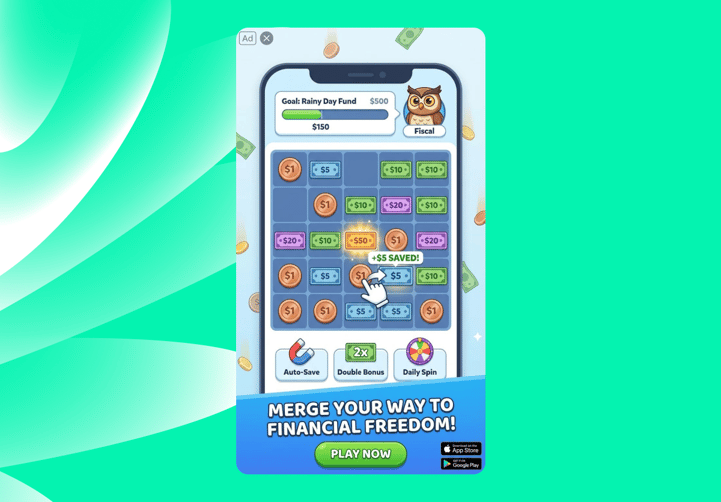
The trend shows that gamification in ads works, even if it’s not 100% aligned with the product. But it’s a fine line: you want the right users. If the ad diverges too much, you’ll get installs from people seeking something else, which hurts long-term ROI.
My advice: if you venture into non-core playable territory, ensure there is some link to your app — theme, aesthetic, or feature. And consider it a testing strategy — measure those users’ retention and quality.
Sometimes a crazy concept ad can become your top performer, and then it’s on you to maybe actually add that mode to your game (seriously, some studios have done this after seeing demand!). Just remember, honesty lasts: a playable that engages and accurately represents your product will build more trust with your audience.
Want to turn all this insight into action? In Part 2, I’ll break down the playable playbook: best practices, production tips, common mistakes, and how to design creatives that scale.

More news
See more


.png)